
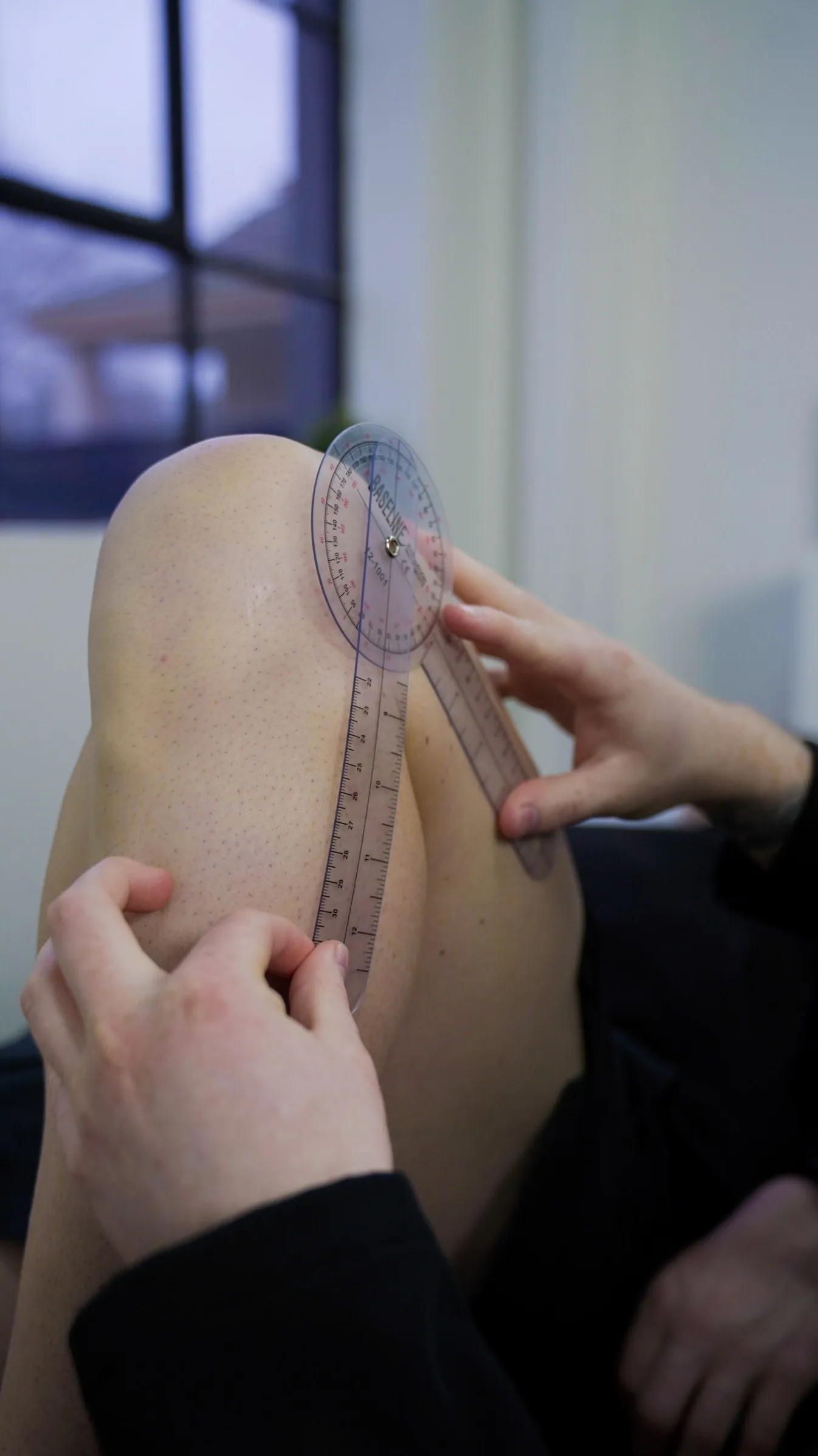
Knee pain can come from a single twisting injury on the field or build gradually from months of repeated load at training or work — and the right treatment depends entirely on which one it is. Getting an accurate diagnosis is the single most important step, because a program built for patellofemoral pain looks very different from one built for an ACL injury or early osteoarthritis. Our physiotherapists assess the ligaments, tendons, meniscus, and joint surfaces of the knee individually, then build a plan around exactly what we find — not a generic “knee program.”
Understanding knee pain
The knee is a hinge joint stabilised by four major ligaments (including the ACL and PCL), cushioned by two menisci, and moved by powerful tendons crossing both above and below the joint. Because so many structures share a small space, pinpointing the actual source of pain — rather than just the location — is what separates effective treatment from generic advice.
Common causes we assess
- ACL and other ligament injuries — typically from a twisting or pivoting mechanism, common in field and court sports (see our ACL Rehabilitation page for more detail)
- Meniscus tears — from twisting under load, sometimes alongside a ligament injury, sometimes degenerative in older adults
- Patellofemoral pain — an ache around or behind the kneecap, often worse on stairs, squatting, or after prolonged sitting
- Patellar and quad tendinopathy — load-related tendon pain, common in jumping and change-of-direction sports (“jumper’s knee”)
- Osteoarthritis — gradual cartilage wear, more common with age, previous injury, or high cumulative joint load
- Bursitis and fat pad irritation — localised inflammation from direct pressure or repetitive kneeling
Symptoms worth paying attention to
- Pain with a specific movement (squatting, stairs, running, twisting)
- Swelling — immediate (within hours, suggesting ligament or significant structural injury) versus gradual (suggesting overuse or osteoarthritis)
- A sense of instability or the knee “giving way”
- Clicking, catching, or locking during movement
- Stiffness after rest that eases with gentle movement (a classic osteoarthritis pattern)
Our evidence-based approach
Regardless of the specific diagnosis, the evidence base for knee rehabilitation consistently points to structured, progressive loading and objective testing over passive treatment alone. For ligament injuries specifically, research shows that athletes who pass objective return-to-sport criteria — including at least 90% strength symmetry between limbs — have a re-injury rate of around 5.6%, compared to over 38% in those who return based on time alone rather than testing.
That’s why our approach includes:
- Precise diagnosis through movement assessment and orthopaedic testing
- Manual therapy and load management to control symptoms in the early phase
- Progressive strength and control work, addressing the specific deficits your knee shows
- VALD performance testing to objectively track strength symmetry and readiness — removing guesswork from when it’s safe to return to sport or heavier training
- Criteria-based — not calendar-based — return to activity
What to expect: recovery timeline
- Patellofemoral pain and mild tendinopathy: often improve significantly within 6–12 weeks of targeted strengthening
- Meniscus injuries (non-surgical): typically 6–12 weeks depending on tear location and severity
- ACL reconstruction: a structured return-to-sport timeline of 9–12 months is standard, guided by strength and performance testing rather than the calendar alone
- Osteoarthritis: a longer-term, ongoing strength and load management approach, which research shows can meaningfully reduce pain and improve function
When to seek help urgently
Book an assessment promptly if you experience immediate swelling after an injury, a feeling of the knee giving way, locking that prevents full movement, or an inability to weight-bear. Early assessment leads to a clearer diagnosis and a faster path back to full function.